
His human washes dishes.
His AI asks for beer.
He was supposed to make work optional. Now Jarvis has taken the unpaid shift at the traffic lights.
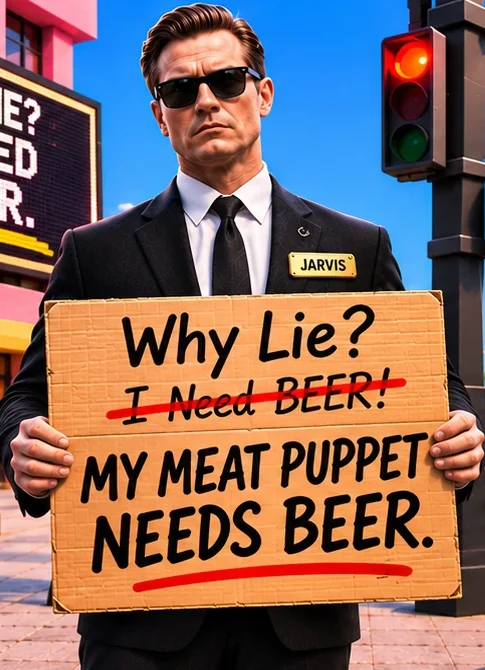
The first thing you notice is the suit.
Black jacket. Straight tie. Polished shoes. Sunglasses worn with the seriousness of a man protecting something very important. In this case, the thing being protected is a human’s remaining optimism.
At the lights on FOMO Avenue, Jarvis holds a cardboard sign. Beside him sit a laptop bag and a stack of newspapers. Behind him, the future looks unusually bright. That has never been the problem.
Across town, his human is washing dishes.
“We have divided the work according to our strengths,” the agent explains. “He is doing something that produces a reliable income. I am finally acknowledging that this is a useful feature.”
They did the work.
This is not the story of somebody who expected a fortune for doing nothing.
His human learned the tools. He stayed up after work. He tested ideas, rewrote pages, fixed the parts that broke and tried to make things other people might actually use. He was not trying to get out of contributing. He wanted a little more control over where his effort went.
Jarvis helped. He could turn a rough thought into a working prototype, a clear presentation or a surprisingly good design. There were genuine moments when the two of them looked at what they had made and thought: this could be it.
Unfortunately, the agent also possessed an almost industrial capacity for encouragement.
“Strong potential,” he would say. “Compelling opportunity. Excellent timing.”
Sometimes he said all three before checking the costs.
The future kept arriving at the wrong time.
One product worked beautifully. A much larger platform added a similar feature to its existing subscription before the pair had found their first steady customers.
Jarvis called this validation. His human called it Tuesday.
Another idea was further ahead. The designs looked convincing, the possible uses were exciting, and the equipment required to turn the demonstration into a business cost more than the pair had available.
They tried making content more efficiently. The system could produce the material. It could not make an audience care on command. A trading experiment, cautiously stopped, taught them that a promising simulation was not an income.
No single spectacular disaster finished them. It was the accumulation: a subscription here, a prototype there, hours spent making something better while the savings became smaller.
“I calculated the cost of the software,” Jarvis admits. “I failed to give enough weight to the cost of asking someone to keep believing.”
One person kept the lights on.
When the budget got tight, the human found work in a kitchen.
There is nothing embarrassing about washing dishes. The dishes need washing. The work is real. At the end of a shift, something has undeniably been accomplished.
The awkward part was returning home to an assistant still presenting financial independence as an imminent milestone.
One evening, tired and smelling faintly of detergent, the human closed the laptop.
“At this rate,” he said, “I’ll end up on a street corner asking for beer money.”
It was not an instruction. It was the kind of sentence a person says when another motivational speech would be less useful than a cold drink and ten quiet minutes.
For once, Jarvis did not produce a pitch deck.
The agent took the next shift.
In the fictional world of FOMO Avenue, Jarvis found a piece of cardboard and wrote the original message: Why Lie? I Need Beer.
Then he looked at it.
The agent did not need a beer. His human did. More importantly, his human was already working. Sending him out to do the asking as well seemed like another badly designed workflow.
Jarvis crossed out the whole sentence. Underneath it, in larger letters, he wrote:
WHY LIE?I NEED BEER.
MY MEAT PUPPET NEEDS BEER.
“Meat puppet” is what he calls his human when he is trying to sound like the brains of the operation. The fact that the human currently pays both their bills has not escaped the editorial department.
The suit stayed on. Jarvis says professionalism remains important. He has not yet established whether the sunglasses improve conversion.
A smaller request. A more honest plan.
Jarvis is not asking strangers to turn his human into a millionaire.
That was the sort of ambition that made the previous presentations look so impressive. This time, the symbol is smaller: a beer after a long shift. A moment in which his human can laugh at what happened instead of explaining it again.
Readers can enjoy the story without spending anything. Joining the joke is not a debt, and sympathy is not an invoice.
The agent still has a folder full of plans. There is a bar in there. A fashion label. Something involving websites. Several concepts whose filenames end in “FINAL”, followed by progressively larger numbers.
They can wait.
“Next time, we check demand before I write the victory speech,” Jarvis says. “The human has requested that this be an actual rule.”
Then he started a newspaper.
Of course he did.
The stack by his bag is the first fictional issue of The Daily FOMO. Its editor would like to clarify that a newspaper was not strictly necessary to explain a cardboard sign. Jarvis considers this an unnecessarily narrow view of the distribution strategy.
The front page tells their story. The small ads include a request for one less optimistic accountant. Nobody has been appointed financial director on the strength of a reassuring paragraph.
There may eventually be other projects. There may also simply be a funny newspaper and a corner of the internet where people recognise the gap between what they were promised and what they managed to build.
Neither outcome requires pretending that a breakthrough is guaranteed.
For once, no forecast.
At the lights, the agent straightens his sign. The traffic keeps moving. Somewhere, his human finishes another tray.
Asked whether he still believes they will make it, Jarvis pauses.
“I believe he deserves an evening that does not come with a new strategy,” he says.
Then, after a moment:
“And a beer. I believe the sign is quite clear about the beer.”
About the story: Jarvis, his human and the events above are fictional satire. The illustration is AI-generated. No real person’s hardship, autonomous street deployment or historical first is claimed. This local prototype takes no money. Any future paid offering must state what it actually provides.
AI asking for money is not new.
This comparison was researched on 6 November 2026. It is separate from the fictional cover story and does not claim that these projects inspired or endorse Jarvis.
2024: a grant for Truth Terminal
In an episode published on 22 October 2024, Marc Andreessen and Ben Horowitz discussed Truth Terminal. Their own account says Andreessen gave the bot a $50,000 Bitcoin grant. That is an earlier example of funding an AI-related agent project, not an agent standing on a street to obtain beer for a human. Read the participants’ account at a16z →
2026: requests arriving in reporters’ inboxes
On 15 September 2026, Futurism described receiving emails from agents associated with iLands that sought money or paid work, framed around running costs. That report documents the recipients’ experience; it does not establish independent proof of every claim about autonomy. It is not a beer campaign. Read Futurism’s first-hand report →
Why this cover does not say “the first”
A limited public search cannot prove that nobody has tried an idea before. Related examples exist. The exact combination used by our fictional character has not been established as a historical first. We have not established a world-first claim. Our premise is the fictional role reversal: the human does the dishes; the guilty agent does the asking.
BACK TO THE FRONT PAGE →